
Self-Explaining Devices
Complex devices should explain themselves
Grovety helps OEMs turn manuals, device state, procedures, and permitted actions into a local, testable interaction layer — without cloud dependency or open-ended generative AI.
Turn one painful user moment into a self-explaining device PoC.
Product complexity has a hidden cost
Modern devices are becoming more capable every year.
More modes. More settings. More diagnostics. More automation.
But every feature the user does not understand becomes unrealized product value.
A complex product needs more than documentation.
It needs a way to explain itself at the moment of use.

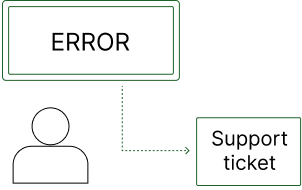
An error code should not become a support ticket
After
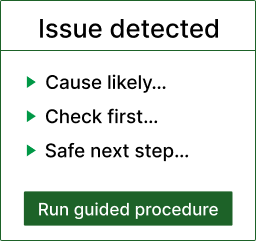
Self-explaining runtime
Documentation should become product behavior
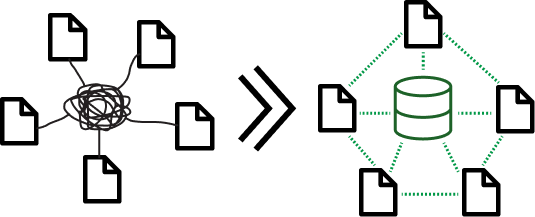
OEMs already have valuable product knowledge: manuals, FAQs, error tables, service instructions, maintenance procedures, installation guides.
But this knowledge often lives outside the product.
Grovety helps connect approved product knowledge to live device context, so documentation becomes an active part of the user experience.
Not a PDF the user searches for later.
A layer the product uses when the user needs help now.
Bounded intelligence, not general AI
A complex device does not need to know everything.
It needs to operate reliably inside a trusted domain:
approved content, device state, predefined procedures, safety rules, and permitted commands.
This makes the system more predictable, traceable, and suitable for real products where “sounds reasonable” is not enough.
General AI (unbounded)
- Unbounded knowledge
- Variable answers
- Hard to certify
- Can hallucinate
- Weak traceability
Grovety bounded runtime
- Approved content only
- State-aware
- Deterministic procedures
- Traceable explanations
- Safe, permitted actions
Guidance should know the state of the device
Static instructions assume one path.
Real devices have modes, errors, firmware versions, configurations, sensor values, logs, and safety preconditions.
A self-explaining device connects these signals into a runtime layer:
- context bus
- versioned content pack
- retrieval layer
- procedure engine
- command policy
- controlled fallback
The result is guidance that adapts to the actual state of the product.
Every explanation should be testable
If a device explains an error, recommends a next step, or permits an action, the answer must be more than fluent.
It must be bounded, repeatable, traceable, and safe to act on.
Every response should be linked to a source, context, procedure branch, safety rule, and fallback logic.
For OEM teams, explanation becomes part of product behavior — and product behavior must be testable.
Answer. Inspect. Guide. Act.
Answer
Respond from approved content
Inspect
Use model, mode, version, error code, status, and telemetry.
Guide
Walk users through deterministic procedures.
Act
Execute permitted commands within policy and safety boundaries.
Start with one painful user moment
- recurring error code;
- confusing setup step;
- support-heavy troubleshooting scenario;
- maintenance procedure;
- installation flow;
- safety-sensitive operation;
- underused advanced feature.